Red-bellied Woodpecker
Melanerpes carolinus
Description:
Size: Medium-sized woodpecker, about 8.5–9.5 inches (21–24 cm) in length with a wingspan around 13–16 inches (33–41 cm).
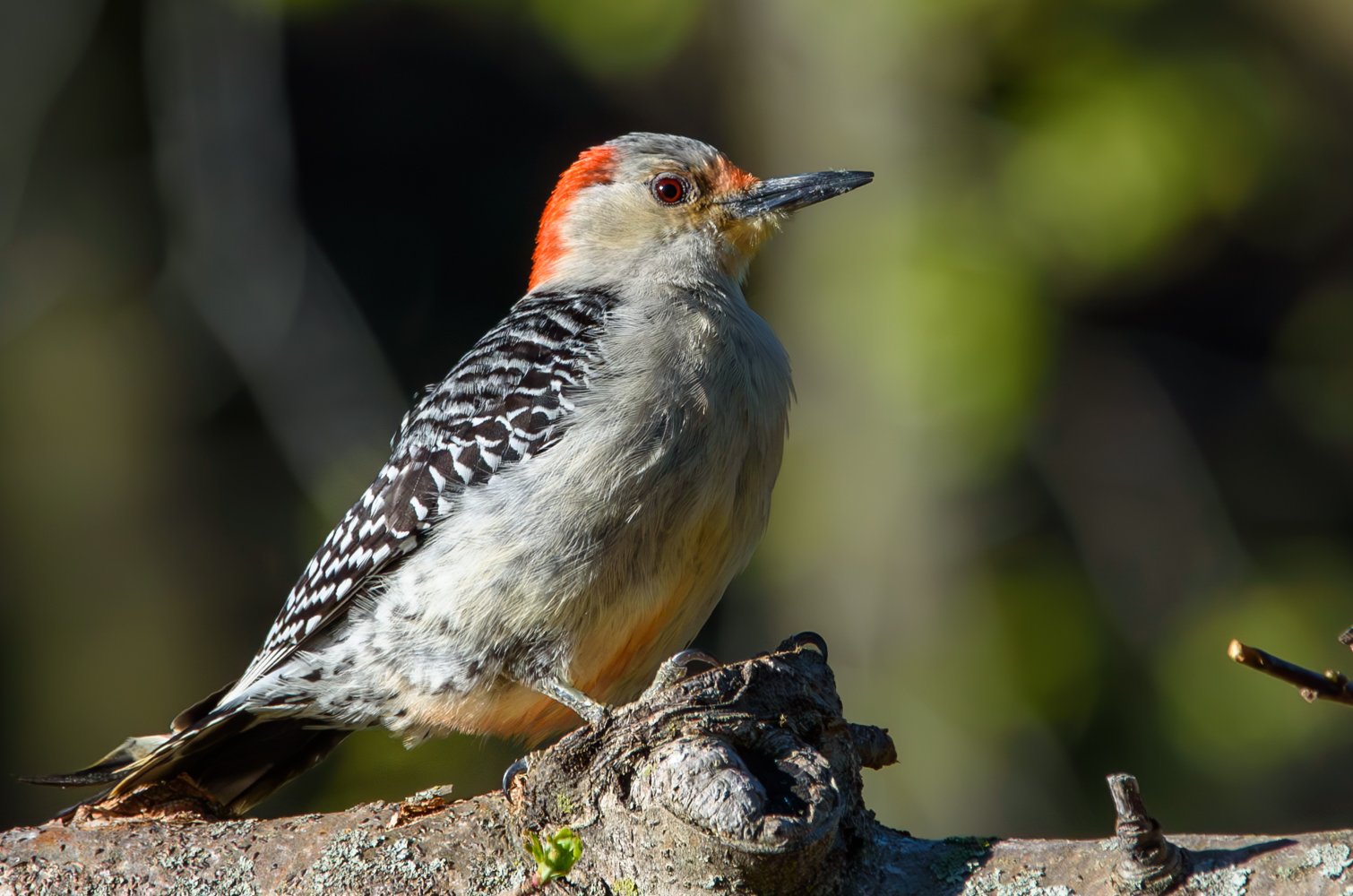
Plumage: Pale, barred black-and-white back and wings creating a crisp, zebra-like pattern. Underparts are pale gray to off-white with a subtle reddish wash on the lower belly and vent area (the “red-bellied” name—often faint and not always easily visible).
Head: Striking red nape and crown on males, extending from the bill over the crown to the nape; females have red mainly on the nape and crown limited to the rear of the head. Face and cheeks are pale with a contrasting black line through the eye in some individuals.
Bill and legs: Stout, slightly curved bill for probing and chiseling; legs strong and zygodactyl (two toes forward, two back) for climbing trunks.
Behavior: Active and acrobatic foragers that cling to tree trunks and branches, often moving in a jaunty, undulating manner. They feed on insects (including beetles and larvae), fruits, nuts, and seeds; will commonly visit backyard feeders for suet, peanuts, and sunflower seeds. Known to store food in crevices.
Voice: Loud, rolling "churr" or "chuk" calls and a sharp, repeated “chur-r-r” used for communication; also drums on resonant surfaces.
Habitat and range: Wooded suburbs, deciduous forests, orchards, and parks across the eastern United States and into the central U.S.; non-migratory, resident year-round.
Distinguishing features: Black-and-white barred back, pale face, and the male’s red crown and nape; the often-subtle reddish wash on the belly differentiates it from other similar woodpeckers.
Digital download for personal use.
(For commercial use permission and cost contact: Richard7695@comcast.net)
Red-bellied Woodpecker
Melanerpes carolinus
Description:
Size: Medium-sized woodpecker, about 8.5–9.5 inches (21–24 cm) in length with a wingspan around 13–16 inches (33–41 cm).
Plumage: Pale, barred black-and-white back and wings creating a crisp, zebra-like pattern. Underparts are pale gray to off-white with a subtle reddish wash on the lower belly and vent area (the “red-bellied” name—often faint and not always easily visible).
Head: Striking red nape and crown on males, extending from the bill over the crown to the nape; females have red mainly on the nape and crown limited to the rear of the head. Face and cheeks are pale with a contrasting black line through the eye in some individuals.
Bill and legs: Stout, slightly curved bill for probing and chiseling; legs strong and zygodactyl (two toes forward, two back) for climbing trunks.
Behavior: Active and acrobatic foragers that cling to tree trunks and branches, often moving in a jaunty, undulating manner. They feed on insects (including beetles and larvae), fruits, nuts, and seeds; will commonly visit backyard feeders for suet, peanuts, and sunflower seeds. Known to store food in crevices.
Voice: Loud, rolling "churr" or "chuk" calls and a sharp, repeated “chur-r-r” used for communication; also drums on resonant surfaces.
Habitat and range: Wooded suburbs, deciduous forests, orchards, and parks across the eastern United States and into the central U.S.; non-migratory, resident year-round.
Distinguishing features: Black-and-white barred back, pale face, and the male’s red crown and nape; the often-subtle reddish wash on the belly differentiates it from other similar woodpeckers.
Digital download for personal use.
(For commercial use permission and cost contact: Richard7695@comcast.net)